AI/ML Engineer Virtual Internship
You pick an industry — banking, healthcare, telecom, retail, manufacturing, energy, automotive or EdTech — and the platform generates a project from what AI/ML engineers are being hired to do in that sector today. You build it in three sprints inside the browser, an AI evaluator checks your code as you go, and a working data scientist approves each sprint before the next one opens.
Reviewed by data scientists in deep learning and NLPWhat you will work on
- Data preparation and feature engineering
- Model training and evaluation (classification, regression, clustering)
- Deep learning with PyTorch or TensorFlow
- NLP or computer vision, depending on the domain
- MLOps basics: experiment tracking, model packaging, a deployable inference endpoint
- Documentation: a PRD and HLD that a reviewer signs off before you code
Sample project brief
Illustrative — your project is generated for you
Predictive maintenance for a manufacturing line.
A plant records vibration, temperature and current readings from 40 machines every minute. Build a model that flags a machine likely to fail within the next 24 hours, expose it as an API the plant's dashboard can call, and show the maintenance team why each alert fired.
- 1
Sprint 1 — Data pipeline and baseline: clean the sensor feed, engineer rolling-window features, train a baseline classifier and report precision/recall on a held-out month.
- 2
Sprint 2 — Model and explainability: compare a gradient-boosted model with a sequence model, pick one on a documented metric, add per-alert feature attributions.
- 3
Sprint 3 — Serve and monitor: package the model, expose a /predict endpoint with input validation, log predictions, and write the runbook a plant engineer would follow.
Build Across Real-World Domains
FinTech
Financial technology, banking systems, and secure transactions
E-commerce
Online retail, inventory management, and customer experience
Healthcare
Medical data analysis, patient management, and health tech
Telecom
Network optimization, signal processing, and communication systems
Automotive
Autonomous driving, vehicle diagnostics, and smart transport
Manufacturing
Supply chain optimization, predictive maintenance, and IoT
EdTech
Learning systems, student analytics, and gamification
Energy
Smart grid management, renewable tracking, and consumption analysis
This is how you build real experience.
A high-intensity, industry-verified journey from learning to landing.
Choose role
Select your career path and target industry.
AI generates projects
Market-driven scenarios based on real job postings.
Understand problem
Analyze real-world use cases and business requirements.
Build in sprints
Execute your project using milestone-based agile sprints.
AI evaluates
Get instant automated feedback and code analysis.
Human review
A reviewer approves each sprint with written feedback.
Get scored + verified
Earn a certificate with a public verification link, backed by your score.
Show projects
Deploy and showcase your verified work to top companies.
Industry-Verifiable Certificates
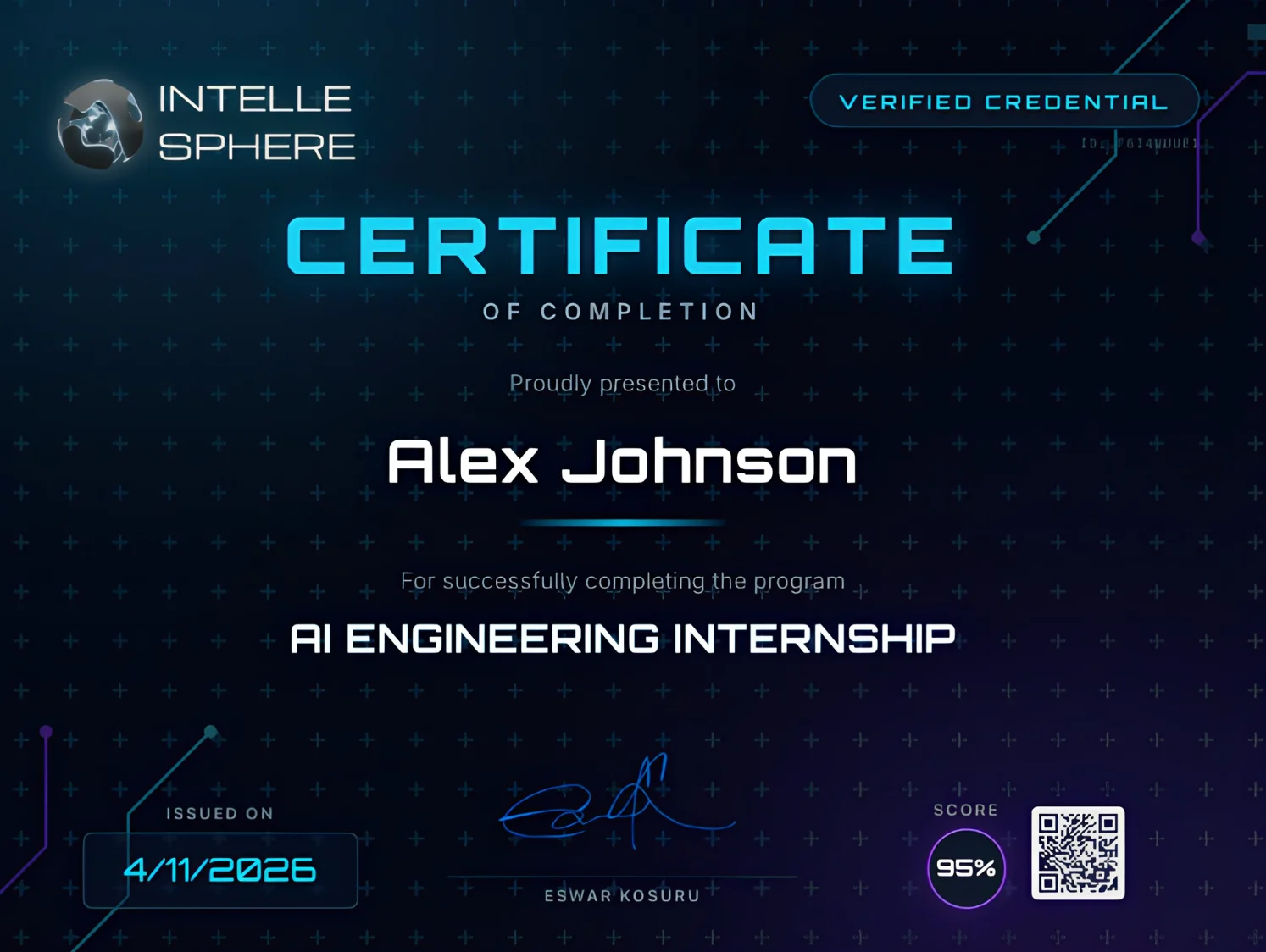
Unique Verification URL
Each certificate links to a verifiable public page
Publicly Verifiable Record
Anyone with the link can check the certificate and its score
Score-Based Evaluation
Reflects real performance across all sprints
LinkedIn Ready
You can showcase directly on LinkedIn profiles
Questions about the AI/ML Engineer internship
Do I need prior ML experience?
You need Python and basic statistics. The first sprint is scoped so a final-year student with one ML course can complete it; the reviewer feedback is where the learning happens.
Which tools are used?
Python, pandas, scikit-learn, and PyTorch or TensorFlow, all inside the in-browser environment. No local installation.
How long does it take?
Three sprints per project, two projects for the certificate. Most students spend 60–80 hours per project; there are no fixed cohort dates.
What does the certificate show?
Your score across all sprints, the reviewer's sign-off, the project summary, and a public verification URL.