GenAI Developer Virtual Internship
GenAI developer postings ask for things a course rarely makes you do: ground a model in company documents, measure whether its answers are right, keep it from leaking data, and ship it behind an API. Your project is generated from those requirements for the industry you choose, and a practitioner who builds these systems approves every sprint.
Reviewed by practitioners in LLMs, RAG and agentic AIWhat you will work on
- Prompt design and structured outputs
- Retrieval-augmented generation: chunking, embeddings, vector search, re-ranking
- Evaluation: building a test set, measuring faithfulness and answer quality
- Guardrails: PII handling, prompt-injection defences, refusal behaviour
- Tool use and simple agents
- Cost and latency tracking
- PRD and HLD approved before coding
Sample project brief
Illustrative — your project is generated for you
Policy assistant for an insurance back office.
Claims staff spend hours searching 300 policy wording PDFs. Build an assistant that answers questions with citations to the exact clause, refuses questions outside the documents, and logs every answer for audit.
- 1
Sprint 1 — Ingest and retrieve: parse the PDFs, chunk and embed them, build retrieval that returns the right clause for 20 benchmark questions.
- 2
Sprint 2 — Generate and evaluate: add the LLM layer with citations, write a 50-question evaluation set with a faithfulness score, and get it above the reviewer-set threshold.
- 3
Sprint 3 — Harden and ship: add PII redaction, injection tests, an audit log and a rate-limited API, with a cost-per-query report.
Build Across Real-World Domains
FinTech
Financial technology, banking systems, and secure transactions
E-commerce
Online retail, inventory management, and customer experience
Healthcare
Medical data analysis, patient management, and health tech
Telecom
Network optimization, signal processing, and communication systems
Automotive
Autonomous driving, vehicle diagnostics, and smart transport
Manufacturing
Supply chain optimization, predictive maintenance, and IoT
EdTech
Learning systems, student analytics, and gamification
Energy
Smart grid management, renewable tracking, and consumption analysis
This is how you build real experience.
A high-intensity, industry-verified journey from learning to landing.
Choose role
Select your career path and target industry.
AI generates projects
Market-driven scenarios based on real job postings.
Understand problem
Analyze real-world use cases and business requirements.
Build in sprints
Execute your project using milestone-based agile sprints.
AI evaluates
Get instant automated feedback and code analysis.
Human review
A reviewer approves each sprint with written feedback.
Get scored + verified
Earn a certificate with a public verification link, backed by your score.
Show projects
Deploy and showcase your verified work to top companies.
Industry-Verifiable Certificates
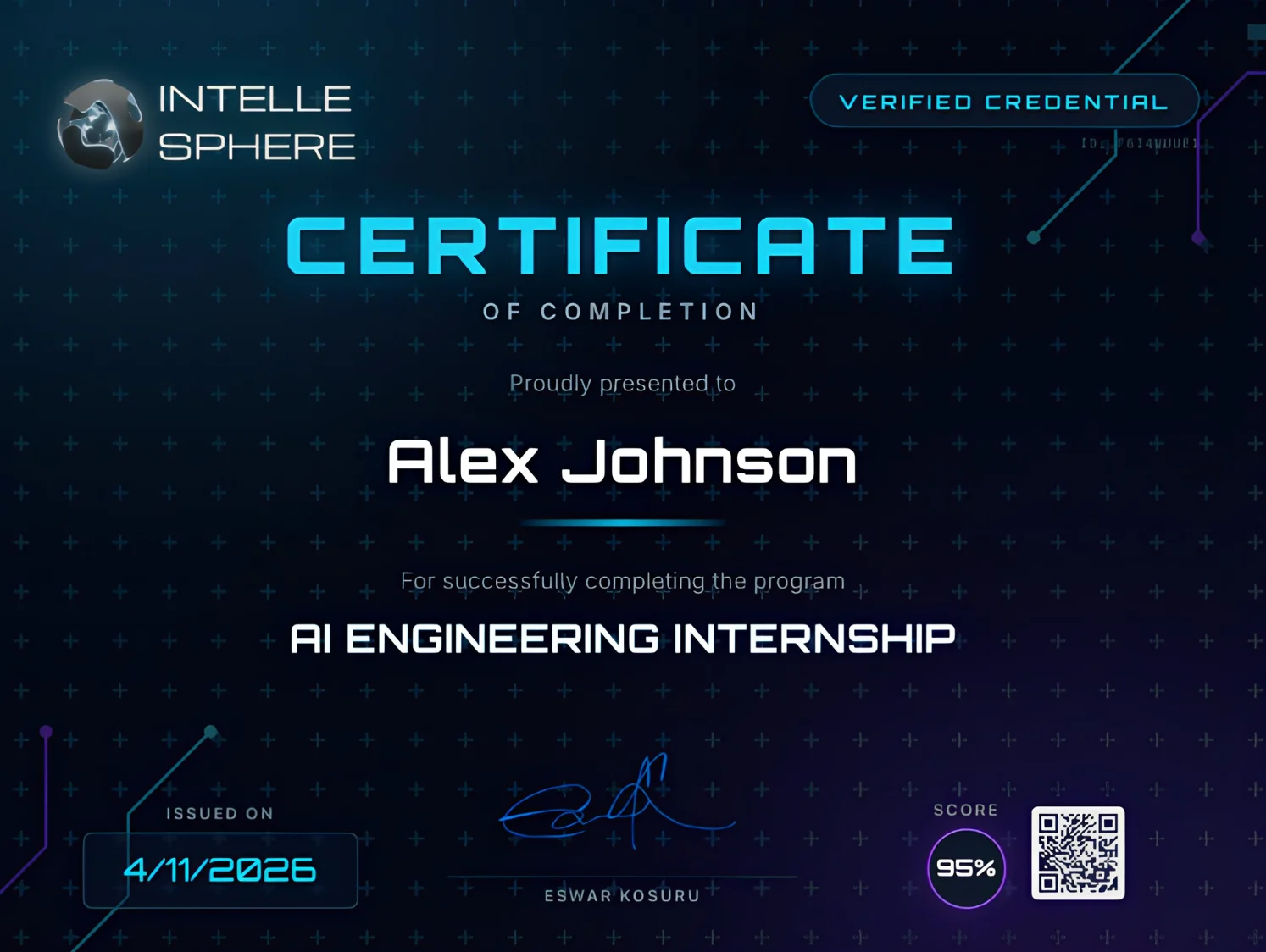
Unique Verification URL
Each certificate links to a verifiable public page
Publicly Verifiable Record
Anyone with the link can check the certificate and its score
Score-Based Evaluation
Reflects real performance across all sprints
LinkedIn Ready
You can showcase directly on LinkedIn profiles
Questions about the GenAI Developer internship
Which models and frameworks?
The in-browser environment provides API access to a hosted LLM plus Python libraries for embeddings and vector search. The brief states which; you are not asked to pay for API keys.
Is this prompt engineering?
Prompting is one week of it. The reviewer gates are about retrieval quality, evaluation and safety — the parts that get GenAI developers hired.
How long does it take?
Three sprints per project, two projects for the certificate, roughly 60–80 hours per project at your own pace.
What does the certificate show?
Score across sprints, reviewer sign-off, project summary and a public verification URL.