Cybersecurity Engineer Virtual Internship
Security postings ask for evidence, not certifications: have you found a vulnerability, fixed it without breaking the app, and written up what happened so a non-security manager understands it. Your project is generated around those three for the industry you choose, and each sprint is approved by a reviewer before the next opens.
Reviewed by security engineers in threat detection, incident response and vulnerability managementWhat you will work on
- Threat modelling for a real application
- Web application testing against the OWASP Top 10
- Secure code review and remediation
- Authentication, session and secrets handling
- Logging, detection rules and an incident timeline
- Writing a findings report and an incident post-mortem
- PRD and HLD approved before coding
Sample project brief
Illustrative — your project is generated for you
Security assessment and hardening of a healthcare appointment portal.
A clinic's patient portal (provided as a deliberately vulnerable codebase) stores appointments, prescriptions and ID documents. Assess it, fix what you find, and respond to a simulated breach.
- 1
Sprint 1 — Assess: build a threat model, test the portal for injection, broken access control, insecure uploads and weak session handling, and deliver a prioritised findings report with proof for each issue.
- 2
Sprint 2 — Remediate: fix the top findings in code, add input validation, access checks and secure file handling, and prove with tests that each fix holds without breaking features.
- 3
Sprint 3 — Detect and respond: add logging and alert rules, work through a simulated breach from the logs, and write the incident timeline, impact statement and post-mortem.
Build Across Real-World Domains
FinTech
Financial technology, banking systems, and secure transactions
E-commerce
Online retail, inventory management, and customer experience
Healthcare
Medical data analysis, patient management, and health tech
Telecom
Network optimization, signal processing, and communication systems
Automotive
Autonomous driving, vehicle diagnostics, and smart transport
Manufacturing
Supply chain optimization, predictive maintenance, and IoT
EdTech
Learning systems, student analytics, and gamification
Energy
Smart grid management, renewable tracking, and consumption analysis
This is how you build real experience.
A high-intensity, industry-verified journey from learning to landing.
Choose role
Select your career path and target industry.
AI generates projects
Market-driven scenarios based on real job postings.
Understand problem
Analyze real-world use cases and business requirements.
Build in sprints
Execute your project using milestone-based agile sprints.
AI evaluates
Get instant automated feedback and code analysis.
Human review
A reviewer approves each sprint with written feedback.
Get scored + verified
Earn a certificate with a public verification link, backed by your score.
Show projects
Deploy and showcase your verified work to top companies.
Industry-Verifiable Certificates
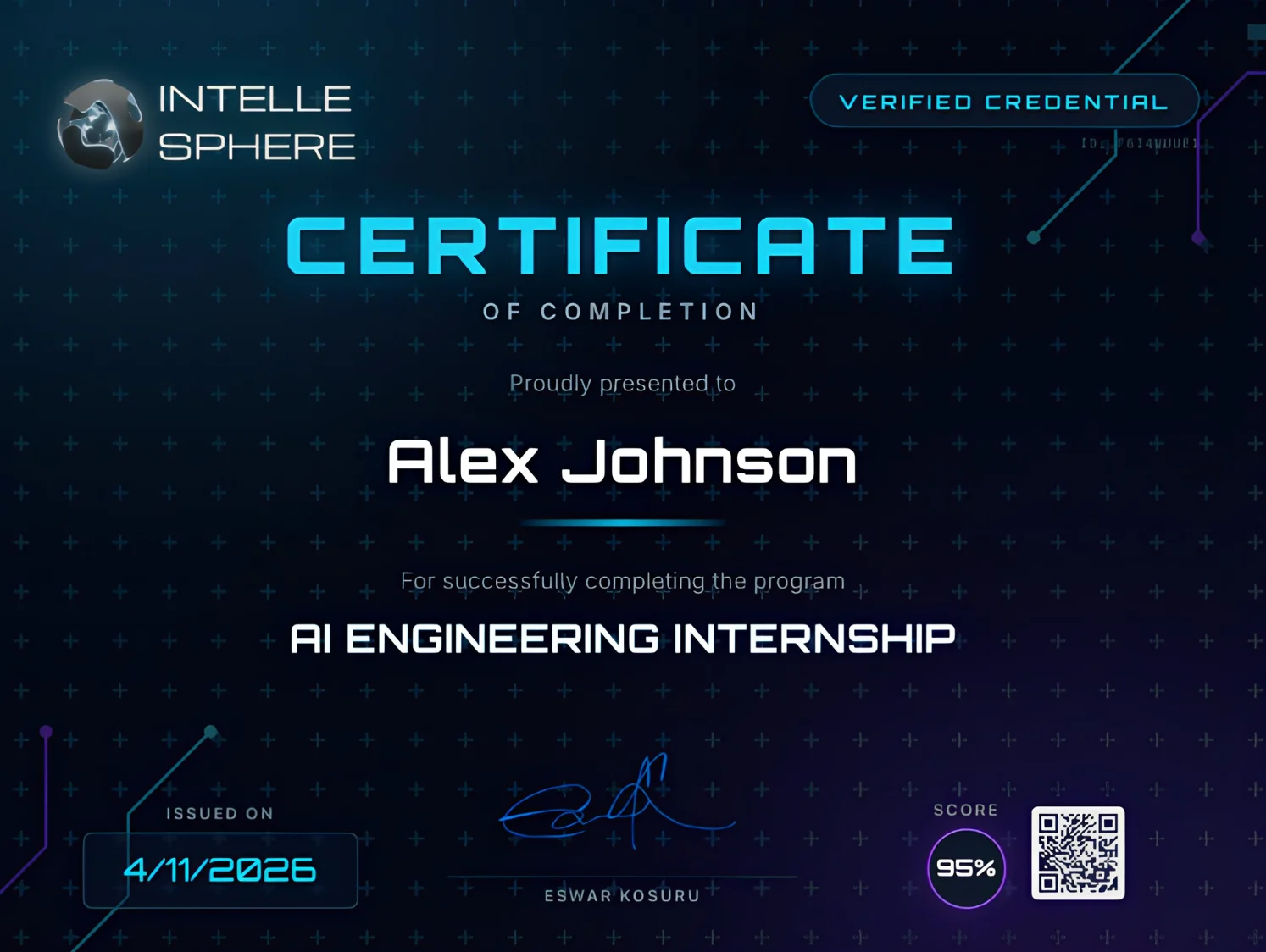
Unique Verification URL
Each certificate links to a verifiable public page
Publicly Verifiable Record
Anyone with the link can check the certificate and its score
Score-Based Evaluation
Reflects real performance across all sprints
LinkedIn Ready
You can showcase directly on LinkedIn profiles
Questions about the Cybersecurity Engineer internship
Is this ethical hacking?
It is the full job: finding issues, fixing them in code, and responding when something gets through. Everything runs on provided codebases inside the platform; you never test systems you do not own.
Which tools?
Browser-based testing tools, the application's own codebase and test suite, and standard logging. The brief names them.
How long does it take?
Three sprints per project, two projects for the certificate, around 60–80 hours per project at your own pace.
What does the certificate show?
Score across sprints, reviewer sign-off, project summary and a public verification URL.